
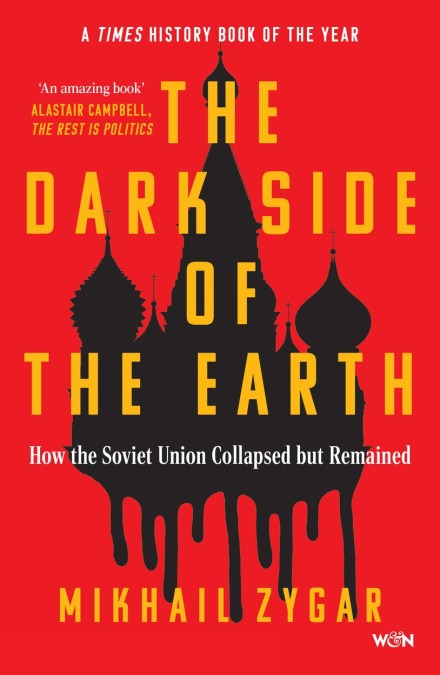
The Dark Side of the Earth
A TIMES BOOK OF THE YEAR
‘Tells the story with a mordant eye, weaving together the disintegration of Mikhail Gorbachev’s reformist ambitions, the implosion of the Soviet economy and the plight of ordinary people’
DOMINIC SANDBROOK
‘Savage, comic and tragic . . . Brilliant’ JOHN CRACE
Who won the Cold War? All my life I thought I knew the answer . . .
In 1961, the Soviet Union put the first man into space. By 1991, it had disappeared. How could just a single generation separate the apex of a civilisation from its collapse? And what remained stirring in its ruins?
Through the lives of that last generation, renowned Kremlin critic Mikhail Zygar reveals the truth about how everything came crashing down. A tale of epic hubris, told with jaw-dropping candour via the memories of its protagonists and victims, this is a masterpiece of narrative history, essential for understanding modern Russia.
‘This is history as it should be: written like a novel and brimming with moral urgency. Extraordinary’
IAN DUNT
‘Pointed, novel, and profoundly relevant’ FOREIGN POLICY
‘One of the most thoughtful Russian writers of our time . . . You may think you know how it all ends, but still, you simply can’t put it down’
YULIA NAVALNAYA
‘Tells the story with a mordant eye, weaving together the disintegration of Mikhail Gorbachev’s reformist ambitions, the implosion of the Soviet economy and the plight of ordinary people’
DOMINIC SANDBROOK
‘Savage, comic and tragic . . . Brilliant’ JOHN CRACE
Who won the Cold War? All my life I thought I knew the answer . . .
In 1961, the Soviet Union put the first man into space. By 1991, it had disappeared. How could just a single generation separate the apex of a civilisation from its collapse? And what remained stirring in its ruins?
Through the lives of that last generation, renowned Kremlin critic Mikhail Zygar reveals the truth about how everything came crashing down. A tale of epic hubris, told with jaw-dropping candour via the memories of its protagonists and victims, this is a masterpiece of narrative history, essential for understanding modern Russia.
‘This is history as it should be: written like a novel and brimming with moral urgency. Extraordinary’
IAN DUNT
‘Pointed, novel, and profoundly relevant’ FOREIGN POLICY
‘One of the most thoughtful Russian writers of our time . . . You may think you know how it all ends, but still, you simply can’t put it down’
YULIA NAVALNAYA
Reviews
Zygar is one of the most brilliant observers of contemporary Russia. He is both a protagonist in his country's recent history and a skilled analyst of its politics. The Dark Side of the Earth showcases his unique perspectives, and considerable talent for vivid storytelling as he looks back at the collapse of the Soviet Union. This is also a deeply personal story, which makes for a particularly powerful narrative and a profoundly moving book
In Zygar's book, it's people who take center stage, not messiahs; individual characters, not abstract nations. We see that it wasn't dictators who saved the world from apocalypse, but humanists. And the contrast with today's rulers makes the book all the more bitter and revealing. And yes, it's brilliantly written - with a lively, sparkling wit
I love books that tell the story of an entire country through the intimate, everyday lives of its people - both famous and unknown. Mikhail Zygar is one of the most thoughtful Russian writers of our time, and behind every page lies meticulous, painstaking work. You may think you know how it all ends, but still, you simply can't put it down
An idiosyncratic, insightful account of both the end of the Soviet Union and the rise of Putinism - a useful and timely reminder of how closely these two forms of dictatorship are connected
This is history as it should be: written like a novel and brimming with moral urgency. An extraordinary piece of work
Blends political history, cultural studies, and biographical narrative to illuminate the persistence of imperial ideology . . . The Dark Side of the Earth reads less like a history book and more like a strategic briefing disguised as cultural analysis. Zygar's central insight is that Russia's post-Soviet trajectory cannot be understood through policy alone - it must be decoded through the stories it tells itself
A marathon effort to retell the story of perestroika through hundreds of interviews [Zygar] conducted over several years with many of the leading participants . . . The tale jumps from one personality to another, weaving world events in the background, meandering across Russia's vast landscape . . . It is a dramatic story, full of wonderful anecdotes . . . Perhaps it is the only way to write about a revolution
A book that will surely endure as the definitive account of an historic era, and serve as a timely reminder that where political systems are concerned, we should perhaps be a little more careful what we wish for.
Tells the story with a mordant eye, weaving together the disintegration of Mikhail Gorbachev's reformist ambitions, the implosion of the Soviet economy and the plight of ordinary people
Weaves the lives of die-hard apparatchiks with the dreams of young Russian musicians more inspired by Dylan than Dostoevsky . . . A challenging but rewarding read
Encased within a moving personal narrative, and with an honesty and genuine wit from start to finish, The Dark Side of the Earth is a story of a country's soul, as seen through the everyday lives of its people. A work of moral urgency, Zygar cuts through the illusions, lies and blurred lines, spelling out the truth of a country that seems caught between the present and the past.
Shows definitively that some leading Russians were lionised by the West for their anti-Soviet views simply on the basis that "my enemy's enemy is my friend" rather than dealing with them in the round
An amazing book . . . From Steven Spielberg on down, the filmmakers of the world should get on this story of Gorbachev and Yeltsin and all the things that could have gone in a different direction
Marking an important turn in Zygar's career, The Dark Side of the Earth signals his shift from chronicler of political life to a thinker about cultural politics . . . Zygar reminds us that Russia is not some mysterious enigma, but rather a violent, nihilistic mirror of what other polities might equally become . . . Pointed, novel, and profoundly relevant
Exiled Russian journalist Zygar delivers a sobering portrait of Russia's brief moment in democratic sunlight . . . An extraordinarily revealing account of how the Russia we know from today's headlines came into being
This is history as experience, systems rendered through the lives they shape and often destroy . . . The Dark Side of the Earth shines
Savage, comic and tragic. Mikhail Zygar's brilliant eye-witness account of the end of the Soviet Union takes you to the heart of modern Russia