
‘Offers a road map for making it easier for parents to trust their kids more, worry about them less, and let them be kids.’ WILLIAM R. STIXRUD, clinical neuropsychologist and co-author of The Self-Driven Child
‘For anyone anxious to understand the real causes of the struggles of recent generations, read this book.’ NED JOHNSON, co-author of The Self-Driven Child
‘This book will forever change how you see your kids and how they see themselves.’ JENNIFER BREHENY WALLACE, author of Mattering
____________________________________________________
What if the answer to the youth mental health crisis isn’t less screen time-but instead, more independence?
We have spent the last few decades laser-focused on improving safety for children. We have supervised them more, and made their lives more achievement-oriented, with the good intentions of helping them find success in the increasingly competitive adult world. But what if all that protection is part of the reason kids are now struggling?
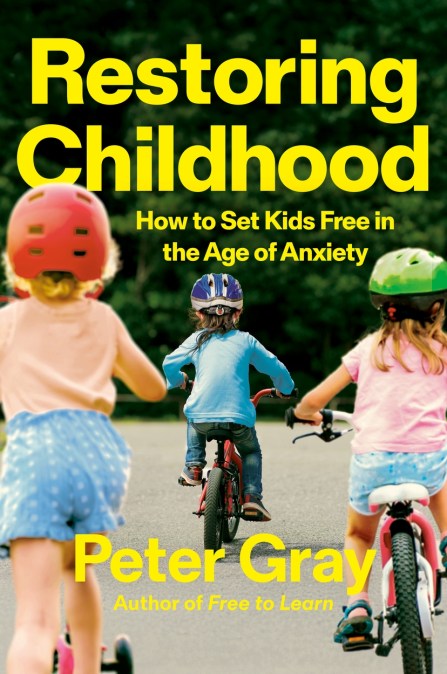
In Restoring Childhood, author, researcher, and psychology professor Peter Gray argues that children need something that seems to be missing from modern childhood: the freedom to play, explore, solve problems and take age-appropriate risks without adults constantly directing them. When we assume children are fragile, it becomes a self-fulfilling prophecy. Overprotection leads to increased rates of anxiety and depression in children, but, as Restoring Childhood shows, independence builds children’s confidence, resilience, and emotional strength.
Restoring Childhood is a radical examination of how certain societal trends – from round-the-clock news coverage, to increasing reliance on cars, to growing wealth inequality – conspired to create a fundamentally anti-child environment. And if we continue to tighten the leash on our kids, no amount of screen-time restriction will reverse the alarming mental health crisis we see our kids enduring today.
We must restore childhood to children. We must, individually and collectively, prioritise adult-free play, and the time and space for it – in our schools, in our neighbourhoods and as parents.
__________________________________________________
‘Asks us to look at how our love, fear and obsession with perfection may be getting in the way of what our kids desperately need.’ Julie Lythcott-Haims, author of How to Raise an Adult
‘Peter Gray is one of the world’s experts on the evolution of childhood play . . . He forces us to rethink our convictions on how schools should be designed to accommodate the ways that children learn.’ STEVEN PINKER
‘For anyone anxious to understand the real causes of the struggles of recent generations, read this book.’ NED JOHNSON, co-author of The Self-Driven Child
‘This book will forever change how you see your kids and how they see themselves.’ JENNIFER BREHENY WALLACE, author of Mattering
____________________________________________________
What if the answer to the youth mental health crisis isn’t less screen time-but instead, more independence?
We have spent the last few decades laser-focused on improving safety for children. We have supervised them more, and made their lives more achievement-oriented, with the good intentions of helping them find success in the increasingly competitive adult world. But what if all that protection is part of the reason kids are now struggling?
In Restoring Childhood, author, researcher, and psychology professor Peter Gray argues that children need something that seems to be missing from modern childhood: the freedom to play, explore, solve problems and take age-appropriate risks without adults constantly directing them. When we assume children are fragile, it becomes a self-fulfilling prophecy. Overprotection leads to increased rates of anxiety and depression in children, but, as Restoring Childhood shows, independence builds children’s confidence, resilience, and emotional strength.
Restoring Childhood is a radical examination of how certain societal trends – from round-the-clock news coverage, to increasing reliance on cars, to growing wealth inequality – conspired to create a fundamentally anti-child environment. And if we continue to tighten the leash on our kids, no amount of screen-time restriction will reverse the alarming mental health crisis we see our kids enduring today.
We must restore childhood to children. We must, individually and collectively, prioritise adult-free play, and the time and space for it – in our schools, in our neighbourhoods and as parents.
__________________________________________________
‘Asks us to look at how our love, fear and obsession with perfection may be getting in the way of what our kids desperately need.’ Julie Lythcott-Haims, author of How to Raise an Adult
‘Peter Gray is one of the world’s experts on the evolution of childhood play . . . He forces us to rethink our convictions on how schools should be designed to accommodate the ways that children learn.’ STEVEN PINKER
Reviews
Why do some children grow into happy, capable, and productive young adults - while so many others today struggle with anxiety, depression, and despair? We are all living with a nation-wide crisis in youth mental and physical health. In this landmark book, Peter Gray does more than document the problem - he shows what has gone wrong with how we are raising our children to develop into competent, successful adults. Drawing on decades of research, along with his authentic personal experiences, Gray makes clear that this crisis did not begin with smartphones or social media, but stems from over four decades of declining childhood independence and increasing academic pressure . . . Happily, Gray's is not a message of despair. He points clearly toward practical ways forward, grounded in our human, biological heritage. This is a deeply informed and ultimately hopeful message for parents, educators and policy makers.
Restoring Childhood is the book this moment needs. Peter Gray makes an irrefutable case for letting children be children and lays out a clear path to make it happen. This book will forever change how you see your kids and how they see themselves.
Noted evolutionary psychologist Peter Gray dismantles many assumptions about the impact of social media and other modern threats to youth while offering a robust catalogue of strategies for letting them "off the leash".
Peter Gray is a national treasure who reminds us that nature 'wires' children to play, explore, and seek independence - and that we thwart this inborn drive at our own peril. Fortunately, Professor Gray offers a road map for making it easier for parents to trust their kids more, worry about them less, and let them be kids. If you have kids, work with kids, or just care about kids, please read this remarkable book!
In Restoring Childhood, Gray challenges the simplistic narrative that today's generation is in crisis because of smartphones and social media, and invites us to consider the broader forces reshaping childhood. Thoughtful and deeply hopeful, this book is an important contribution to conversations about what children need to thrive in a rapidly changing world. Gray shifts the focus from restricting children's lives to expanding them.
Peter Gray gently but firmly asks us to look at how our love, fear and obsession with perfection may be getting in the way of what our kids desperately need. Gray sits beside us, holds up the evidence, and invites us to ask, quietly and honestly, "What have we taken from childhood, and what might it take to put it back?"
For anyone anxious to understand the real causes of the struggles of recent generations, read this book. A scrupulously researched, profoundly compelling explanation of what happened to childhood and how to make things right.
In recent years, parents and policymakers have been told that social media is driving a youth mental health crisis. Peter Gray sets the record straight. Children have long been telling us the truth: it is the erosion of their freedom to explore - and damaging school policies - that are doing the harm. With Dr. Gray's insights, we can finally focus on what really matters for kids' wellbeing.