
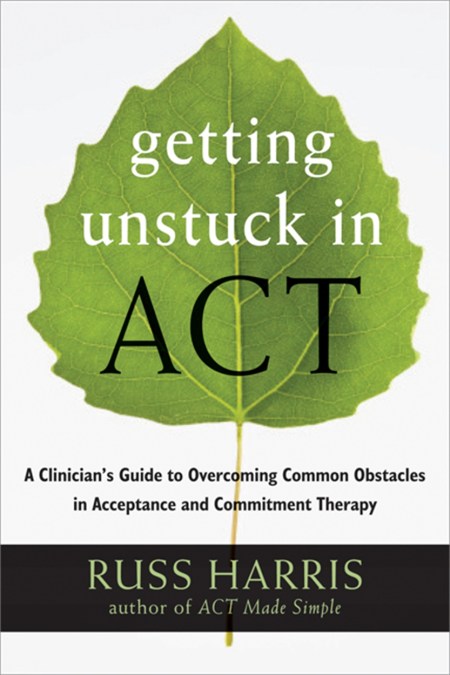
Acceptance and commitment therapy (ACT) is a powerful, evidence-based treatment for clients struggling with depression, anxiety, addiction, eating disorders, and a host of other mental health conditions. It is based in the belief that the road to lasting happiness and well-being begins with accepting our thoughts, rather than trying to change them. However, ACT can present certain roadblocks during treatment. As a mental health professional, you may adopt basic principles of ACT easily, but it generally takes at least two or three years of hard work and ongoing study to become truly fluid in the model. During that time, you will probably find yourself “stuck” at some point, and so will your clients.
In Getting Unstuck in ACT, psychotherapist and bestselling author of ACT Made Simple, Russ Harris, provides solutions for overcoming the most common roadblocks in ACT. In the book, you will learn how to deal with reluctant or unmotivated clients, as well as how to get past certain theoretical aspects of ACT that some clients may find confusing.
This book will help clients deal with sticky dilemmas and unsolvable problems, and will help simplify key ACT concepts to help you break down psychological barriers. Other common problems with ACT that the book addresses are inconsistencies and sending mixed messages, talking and explaining ACT instead of doing it, being too eager to treat a client, being a “Mr. Nice Guy or Ms. Nice Girl,” or putting too much focus on one process while neglecting others. The chapters of the book are based in real life scenarios that take place between therapist and client, and the author provides feedback by analyzing mistakes in what was said and where improvements could be made.
As more and more mental health professionals incorporate ACT into their practice, it is increasingly necessary to have a guide that offers them effective solutions to common ACT roadblocks. For that reason, this book is a must-have for any ACT therapist.
In Getting Unstuck in ACT, psychotherapist and bestselling author of ACT Made Simple, Russ Harris, provides solutions for overcoming the most common roadblocks in ACT. In the book, you will learn how to deal with reluctant or unmotivated clients, as well as how to get past certain theoretical aspects of ACT that some clients may find confusing.
This book will help clients deal with sticky dilemmas and unsolvable problems, and will help simplify key ACT concepts to help you break down psychological barriers. Other common problems with ACT that the book addresses are inconsistencies and sending mixed messages, talking and explaining ACT instead of doing it, being too eager to treat a client, being a “Mr. Nice Guy or Ms. Nice Girl,” or putting too much focus on one process while neglecting others. The chapters of the book are based in real life scenarios that take place between therapist and client, and the author provides feedback by analyzing mistakes in what was said and where improvements could be made.
As more and more mental health professionals incorporate ACT into their practice, it is increasingly necessary to have a guide that offers them effective solutions to common ACT roadblocks. For that reason, this book is a must-have for any ACT therapist.
Reviews
Russ Harris has done it again—written another practical and easy-to-follow book that should be a welcome addition to the library of any acceptance and commitment therapist, from the novice to the most seasoned veteran. This step-by-step troubleshooting guide is the next best thing to a tow truck to get you and your clients out of therapeutic ditch we all too often find ourselves stuck in. Think of it as ACT roadside assistance. If you haven’t needed it yet, take it from one who has—you will. Buy this book and keep it in your glove compartment.
Once again, Russ Harris has delivered a perfect book on acceptance and commitment therapy (ACT). Crystal-clear and friendly, Getting Unstuck in ACT is a survival guide for the fumbles, ‘stuckness,’ and fear that we all experience in the therapy room. This book is the Swiss Army Knife that will sit front and center in my ACT library.
Russ Harris has a well-deserved, worldwide reputation for creating clarity where there is confusion, and simplicity where there is unnecessary complexity. When we are 'stuck' in clinical work, reducing confusion and complexity helps us see a pathway forward. There is wisdom on almost every page of this book. I learned a lot reading it and if you do ACT work, you will too. Highly recommended.